I am three credits away from my diploma being mailed to me. Sure, I walked (well, skipped) at graduation, but I had a little cleanup that had to happen after all was said and done. This project is a product of being left to my own devices (with some gentle guidance from Professor Schlager) in a Special Reading Course that I designed to examine ritual and tradition and what it has to offer to a TikTok attention span, which isn’t super different from ADHD brain at times.
Using the super dense chunks of information on the medieval liturcal day and the practice of the divine office, I am immersing myself in a week-long experiment of keeping the hours of the divine office according to medieval practices.
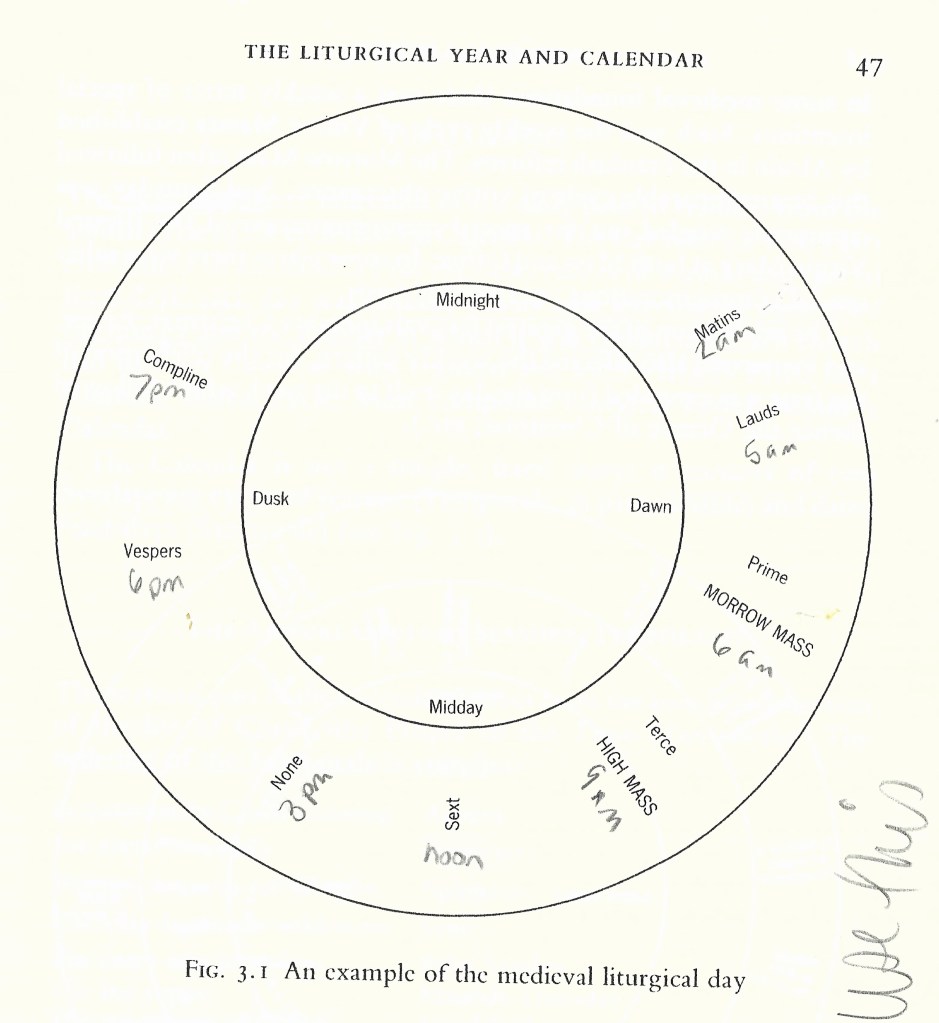
This was absolutely one of those “Okay, so now what” moments. I tend to prefer book learning because a book just tells me things and I don’t have to show how little I know or get vulnerable in any way. I also have a disability that makes it really hard for me to take huge chunks of text and apply them in any real way if I haven’t already got some experience with them. Unfortunately, I learn best by doing. That requires being vulnerable and not showing up knowing everything or being an expert. This project is a way to help me more-than-visualize what these really long (kind of boring, tbh) orders of medieval worship are actually accomplishing.
I come from a mainline protestant background. I know of things like the Gloria Patri, but also never really have to encounter them—and definitely not in latin. Even though the churches I have been part of have skewed more traditional—no contemporary christian worship music, no big band in the chancel, pipe organs, and so on—I would venture to say we are more Tradition Lite™. This is a big move out of my comfort zone, and my brain couldn’t even figure it out until I started doing it.
Every day for the week of December 4–11 I will be doing my very best to figure out and observe the Divine Office according to that wild schedule above, starting with Vespers on the Saturday night—liturgically, Sunday starts with Vespers from the day before. The week also apparently ends with Compline on the following Sunday, which means every week there’s a whole day of overlap. I don’t get it, but maybe I will after I deprive myself of sleep for a week, disrupt my family, and try to figure out what it means to pray the Hours when I can barely remember to eat breakfast. Or lunch. Which reminds me, I haven’t eaten yet today.
Each night, a video will be shared to TikTok to close out the day. This could be really fun, really exhausting, really spiritually engaging, or really awful. Feel free to join me in this journey!
Works Cited:
Harper, John. The Forms and Orders of Western Liturgy from the Tenth to the Eighteenth Century. Clarendon Press, 1991.
 Busy Little Sunshine